Hornero, the builder you need.
A canvas for sketching software architecture as blocks, capabilities and packages, that reads and writes plain Markdown, with Claude wired in.
Free · Local-first · Your diagrams are .md files
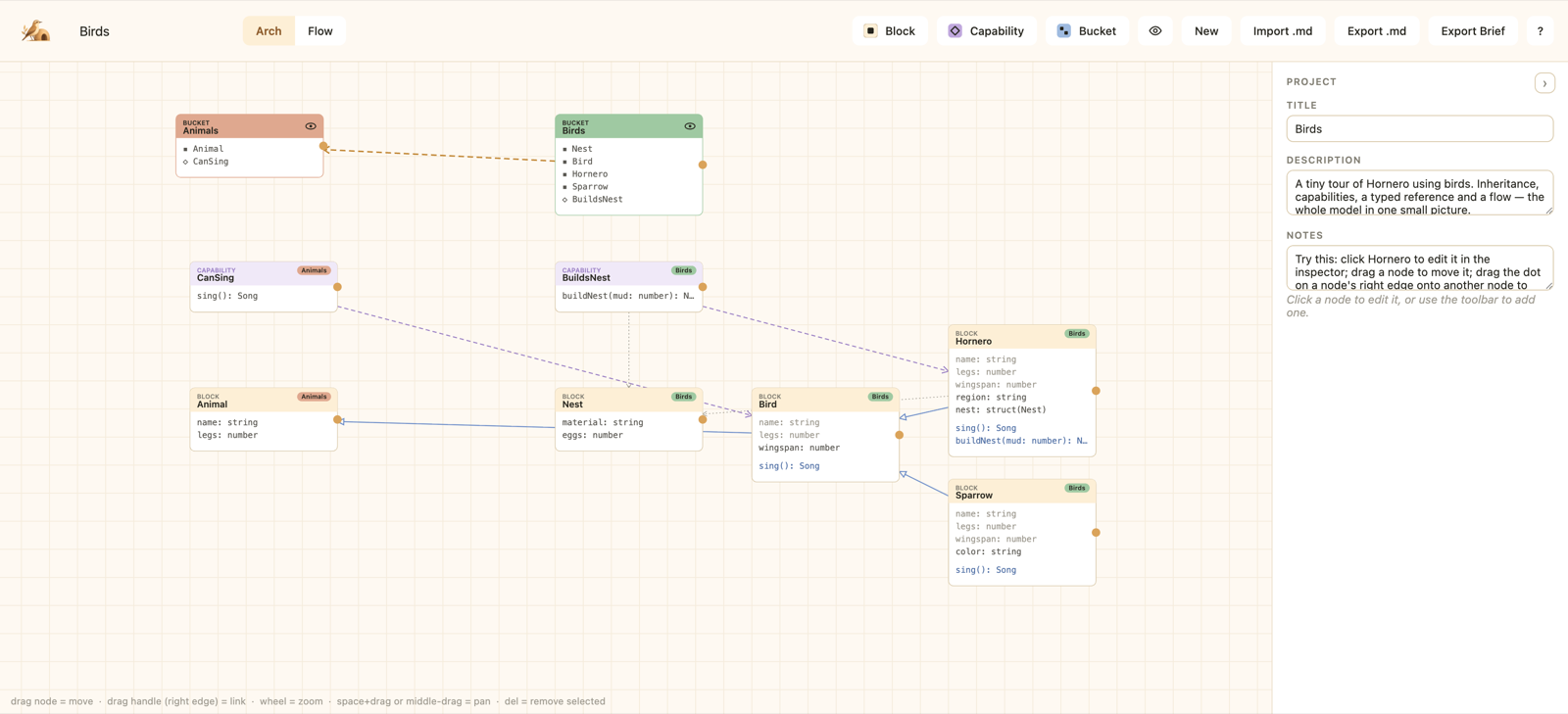
A canvas for sketching software architecture as blocks, capabilities and packages, that reads and writes plain Markdown, with Claude wired in.
Free · Local-first · Your diagrams are .md files
If it isn't simple, it isn't worth building. Hornero exists to make people's lives easier with AI — so the model fits in one breath.
Organization and dependency tracking. Drop blocks in; the arrows between buckets draw themselves — and cycles turn red.
The basic construction thing. A struct, a service, a piece of your system.
What a block can do. Define it once, let any block implement it.
How it runs. Pin numbered steps to your blocks; order, branches and validity draw themselves.
Hornero is a tiny local app for thinking through architecture before writing it — and for keeping that thinking in your repo, not in a screenshot.
Blocks, capabilities and buckets. Inheritance, typed references and bucket dependencies are derived from what you draw — circular dependencies light up in red before they reach your code.
Every diagram is a readable .md file: git-friendly, hand-editable, diffable in PRs. One click exports an LLM-optimized brief with resolved inheritance and reverse references.
A chat panel runs on your Claude Code subscription — no API key. Claude reads and edits the open diagram file directly, and you watch every step.
The terminal install is the quickest path, and it skips macOS quarantine entirely, so the app just opens. Prefer a file? Direct downloads are right below.
RecommendedOr grab the file directly:
Native app via Tauri. The same diagrams also open in any browser if you prefer no install at all.
The chat panel spawns your local claude CLI and bills your existing subscription. Without it, everything else still works.
Local-first. Your diagrams are files on your disk; nothing is uploaded anywhere.